Monday, August 10, 2009

NaSCAR 125 and Bear Lake boating vacation


I've been really busy and then took a week of much needed vacation time so I'm a little behind on my posts, but here's a few photos to show you what I have been up to lately....enjoy!

The week before I went on vacation I got a chance to shoot some photos out at Miller Motorsports Park of Hershel McGriff, an 81 year old race car driver.

Hershel McGriff

I got a nice portrait of him and then some nice photos of him racing at the track last saturday. A spot of bad news with a flat tire on the last lap of the race dropped him down to a 19th place finish. But hey at 81 years of age and driving 175 mph around a race track is pretty darn spectacular in my book.

Hershel talks to his crew chief prior to the race.

Hershel racing at Miller Motorsports Park


But the winner Patrick Long had the best car all day and blew everyone away after every caution restart.

Patrick Long racing at Miller Motorsports Park.


I also got a chance to shoot a quick and dirty portrait of him a couple of days prior to the race. I used a combination of natural light coming into the garage from a door and a little fill light with the Orbis ring flash. Here's the portrait below.

Patrick Long


Here are a few more photos from the NASCAR 650 horsepower circuit race.


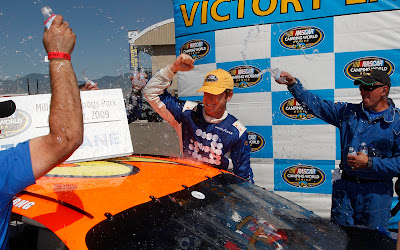
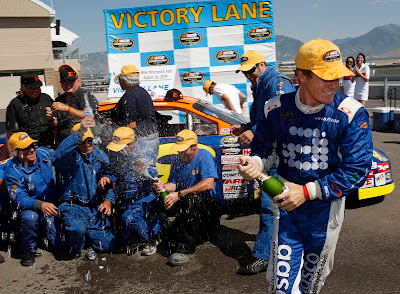
Patrick Long celebrates his victory with his crew.


Patrick Long has a champagne fight with his crew to celebrate his win.

Paulie Harraka catches a little "air" driving the NAPA AutoCare/Adaptive One Brakes Toyota to a second place finish at Miller Motorsports Park.

______________________________________

My next adventure was to go to beautiful Bear Lake, a large fresh water lake which spans the boarders of Idaho and Utah in northeastern Utah. We spent the day kicking back and relaxing with my neighbors and good friends James and Stephanie Andrews and their children Braxton and Lexie on their boat. But me, being me I drug along my Mark III and a 70-200 with a 1.4x and shot some fun photo of them and two of my daughters Mariah and Stormie having fun on a tube being pulled by their boat. We finished the day with pizza and sandwiches at Bear Lake Pizza and ended the meal with chocolate covered raspberries, a Bear Lake specialty. Not a bad day. Anyway here's the photos.


James Andrews catches a little "air" on beautiful Bear Lake in northeastern Utah.

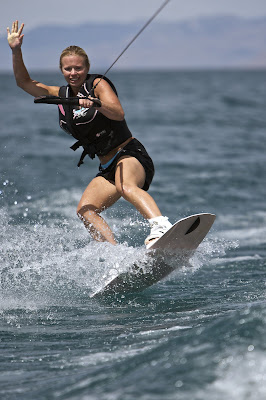
James wife Stephanie wake boards at Bear Lake.

James enjoys wake-boarding on a sun-drenched day at Bear Lake.

(from left) Mariah, Stormie and Braxton have fun on the tube as it is pulled by the boat.


more to come.....

Monday, June 29, 2009

Civility in the Age of Anonymity

A recent blog entry by Salt Lake Tribune photographer Trent Nelson, got me thinking again about civility. Trent wrote about the lack of a calm, civil dialogue in the comment section of stories that had run on the web site where he works at the Salt Lake Tribune. And how he felt that people would be less inclined to let us as journalist's document their lives and stories as a result of the insulting and demeaning comments made whenever a story runs.

I agree with, him. I have been doing a lot of thinking about this as of late. Especially as I have read the comments on our website at the Deseret News, even with our policy to delete many of the more outlandish, mean spirited, off-topic and profane comments from our comment sections that follow our stories, it is still difficult to restore a bit of civility to what is left.

I don't know what the answer is, but when I lack for present answers I try to look at the past to see if bits of wisdom can be gleaned from those who have trod the path before.

I remember my grandfather telling me as we worked together to build a room on the first floor for my great-grandmother who could no longer get upstairs to her room "to always measure twice and cut once". He told me I would make less mistakes that way and learn patience. So when it comes to comments on the web and email, I think we should read everything we've written twice, send once. Maybe this will reduce the impulse to fire off our cyber-mouths before we think about what is actually coming out of them.

Another thought comes from the oft' heard quote, "The character of a man is most often found in what he does when no one is looking" I am not sure who should be originally credited with it, but it is sound advice.

In this age of anonymity, especially on the web, people often say things online in comments and even emails that they would never let slip from their mouths during face to face conversation. Our country seems polarized in it's politics, economics and socially. Society is a dynamic thing, times, language and people do change, great strides have been made in medicine, science and health, things that have made our lives better and more productive. But sometimes these same things that help us can also be a two-edged sword, ready to cut, hurt and maim if used improperly.

As a photo editor and photographer, I look at photographs, I love them as they record the exact time frame wherein they are taken. They are a reflection of what was going on at that time, the hair styles, the clothes, the technology, etc. When I look at them, I am old enough to realize that as much as things change, they also come back. Perhaps now more than ever we need to be reminded that some things should never go out of style, civility for example is something that is sorely needed. It should never be hung in the closet only to be brought out on occasion, but rather snugly fitted around our shoulders every time we set down at the keyboard of our computers or pull a blackberry from our pockets.

Wednesday, June 10, 2009

New Talent- Julie Best Parsons

This is part three in my series of highlighting new photographic talent on my blog.

I first met Julie Best Parsons when my wife Becky and I were asked to chaperon a high school dance. At the time I was looking for a photo assistant and a second shooter for an upcoming freelance assignment taking photos of dance students.

I had used several other photographers in previous years as assistances on big jobs but had not been very happy with some of the effort. So I was in the market to find someone else.

I was looking for someone who could work quickly and efficiently. This assignment had a lot of large groups and limited shooting time. What I needed was someone who could quickly establish rapport with the student, pose and execute the set-ups needed. We only had about 2-3 minutes max with each student. I also needed someone with high-energy, as these photo shoots usually are an all day affair going from early dawn until well after the sun goes down.

As I rotated through the chaperon stations I had a chance to watch the group of about 6-8 photographers that were taking student's photos at the dance.

I noticed one who immediately stood out from the rest. She worked quickly, immediately establishing a rapport with her subject and took command of the shooting situation in a good way putting her subject at ease, while moving them where she wanted to get the best pose and moment out of each situation.

I told my wife Becky and we both spent a minute talking to her and introduced ourselves and we asked her if she would work as our second photographer.

I found out that she was the mother of two children with one on the way; A tri-athlete and a dancer with bundles of energy, enthusiasm and a lot of raw photographic talent.

She has her own small (but growing ) studio in her home in Clinton, Utah where she keeps herself real busy with three small children and a husband. She is one of the local "up and coming" portrait photographers whose work you should take a look at.

Here, in her own words, is how she came to be one of us, you know one of those pixel snapping, lens zooming geeks we lovingly refer to as "memory freezers" or "Professional Photographers" to the rest of you.


Julie Best Parsons

My journey in photography began as something I enjoyed and somewhat of a hobby. Three years ago as my family and I were moving back from living in Colorado an opening come up at a local photography studio that my sister loved. The job was for an office assistant, five days a week. Just having my second child I found myself not being interested in such a position. But after meeting the owner I found out she was looking for an assistant photographer. I showed her some of my work and I was hired. I shadowed her for a while and learned the art of taking newborn and maternity photographs. Soon I was taking my own appointments and began to see the beauty of what I could create behind the camera. I joined the IPPA and began taking any and every photography class I could find. After working for a while at that studio, I began at another on the weekends taking school dance pictures.

After working for a while for other photographers I decided it was time to open my own small studio in my home. Being a mother of three small children I wanted to work from home and start taking pictures for myself. My studio is small but growing everyday, and I love what I’m learning and doing. I’m inspired by finding new ways to make people look beautiful and giving them something to treasure for a lifetime.


More of her work can be found on her website by clicking here.


Friday, May 8, 2009

Great Photo websites and photographers_Robert Seale

This is in the first of several blog entries where I plan to talk about and showcase talent, both more experienced and up and coming photographers that I feel people need to see and learn from.

I wanted to kick this off with Houston, Texas based photographer Robert Seale. Robert has been recently profiled by Adobe as an Adobe Success Story and is a much honored and well known portrait and sports action photographer.


When I found out recently that Robert Seale, had started a blog. I felt compelled to let people know.


I know that another photographer starting a blog is not a big deal as there are a lot of them out there in the blogosphere, but when someone of Robert's photographic talent and stature feels he has something to say or offer via a blog, I think photographers, young and old need to take note.

I believe that so much of what we do in life depends on our interactions with other humans, I feel the best way we can learn and grow in our personal and professional life is by giving back, teaching and sharing with others. Those people who do this, never seem to lose that creativity and passion that keeps them at the top of their respective professions.

I was fortunate enough to be a a photo editor at the Sporting News while Robert was a staff photographer and I can tell you that he is an exceptional portrait photographer. He will downplay his other photographic skills such as sports action, but having been his editor I can tell you he is no slouch at sports actions and I have no doubt would be successful in whatever aspect of photography he chose to pursue. But it is his portrait work which he clearly enjoys and which I want to focus on.

What Robert does so well and which is a common trait among great photographers is that he is a "problem solver". He figures out through, planning, preparation and hard work how to execute his photographic ideas. This planning and preparation allows him to simply fine tune things during the shoot and to overcome obstacles that will inevitably arrive as the shooting process progresses. The old saying "An ounce of prevention is worth a pound of cure" is true. Those photographers who plan and prepare have a much greater success rate than those that don't.

Click here to see his thought processes where he took an idea that had been kicking around in his head for several years and finally put it to good use when the opportunity presented itself.

Another aspect of good photographers is that many of them have what I like to call an "idea log" For some this is a more formal list that they write down, while for others it is a list they keep in their heads. But either way it is the pathway to good photographic execution. For example the great Sports Illustrated photographer Walter Ioos keeps a journal of "unique" backgrounds that he sees in his travels, backgrounds with interesting texture or color etc. and then when he has a portrait shoot he will try and match up the subject with a background that he feels gives him the photographic vision he is looking for on that particular shoot.

Robert had a lot of ideas as well that he catalogues. When you do this, it makes it easier for things to come together when you are trying to come up with something unique. It also helps as you try and get your vision and idea/content of a photograph across to those viewing it.

Sometimes the ideas are put to use and sometimes they don't work out, but it is important to always have them catalogued in some fashion to increase your odds of success.

I remember an idea the Robert had to photograph major league pitcher Dontrelle Willis, currently with the Detroit Tigers, and at that time with the Florida Marlins. Dontrelle has this really high kick during his windup, when he pitches and Robert had this idea to photograph him standing on one leg in his high kick stance with a flock of Pink lawn flamingoes standing on one leg. It was a great idea and would have made a great portrait, but as I remember , (correct me if I'm wrong, Robert) the idea was nixed by his agent and the team who didn't like the idea of their star pitcher being compared to a pink flamingo.

But you get the jist. Catalogue those ideas, write them down, record them or whatever it takes to remember them. Ideas are fleeting and sometimes come at weird times. But they are incredibly useful later on when you suddenly need them. Personally I'm still waiting and hoping to see how the flamingo idea will present itself in some future Robert Seale portrait.

Also another way to grow, and get great ideas is to look at the work of others. Writers, directors, artists and photographers all have great ideas we can all learn from. I frequently encourage young photographers and many of the staff photographers that I work with to look at other photographers work. I tell them, it will refresh your batteries, re-charge your idea bank and most importantly you might just actually learn something you didn't know.

So do yourself a favor and hop on over to Robert Seale's website and blog and see what you can learn. Follow this link.

Also Robert and his good friend Brad Mangin recently visited the Baseball Hall of Fame in Cooperstown, New York, where they were asked to speak at the first annual “Baseball Photography Education Day.” They gave two different presentations during their visit to the museum: a presentation on the history of baseball photography through the years, and another program, delivered together, of their work.

Below are a couple of Robert's baseball images and here is a link to a slide show of these and other baseball images. check it out here.


Monday, April 20, 2009

The "Detail Shot" and the "Details in the Shot"

One of the most overlooked aspects for the beginning and amateur photographer is the "detail shot" And the "Details in the Shot". For years I have been preaching to photographers the value in looking for the details. And here is why.

Frequently when photographers first start out they look to take photos of things that grab their eye, something that has an emotional or visual connection to them. Then they start to learn about, exposure and framing and lens choice etc. and pretty soon they forget about what's within the photo they are taking.

And ultimately that is what is the most important thing. What is within the frame of the photograph we took. What is our emotional connection, what will be the emotional connection for the viewer. What is the importance, the beauty, the context and ultimately the content.

So what does this have to do with detail shots? Well inside the frame you see in the viewfinder of your camera is the image you are trying to take. You usually have a main focus of interest and then other items, people or things in the frame that are part of the image as a whole, but really aren't what caught your eye or what you may be trying to focus on.

So I try to teach young photographers and remind others that you always need to look for the details in the situation you are photographing. Whether that is to look for details in the event that can add to the over Photo "take" of the event or for the details within the frame that can make the photo more visually interesting. The details that can help make the composition inside the frame more interesting or that can add more information to the viewer as to what this person or event or situation is about.

So here are a few photos from my archives that hopefully will show you what I am talking about......


This is a photo from a diabetes conference where I looked for a detail photo that I thought told the story much better than an overall shot of hundreds of people and booths.


This is a detail photo of the Utah Jazz's Andrei Kirilenko's knees after a playoff game. I thought this photograph showed as much about what a hustle player he is, diving after loose balls and defending, than any action shot I took from the action on the court.


This is a portrait of my daughter, but I included the red rock behind her to her right as an icon to show a sense of place and to document where she was when the photo was taken, and I think it makes the photo more visually interesting.


I used a long lens to try an make the hair on the lead singer stand out even more. This detail made the image stronger and I felt would connect with the viewer of the image better.


This is a portrait of the CEO of EnergySolutions Steve Creamer who is a big man in person and has a strong take-no-prisoners type personality. I chose to include the detail of his hands in the portrait to try and help convey some of strength of his personality in the photograph


This is lead singer Jim Lindberg of the group "Pennywise". At the show he kept wrapping the mike cord around his arm, I thought this was an interesting detail that help add to the moment and to his personality.


This is a recent portrait of a former football player for the Nebraska Cornhuskers. I tried to light it to make him the focal point, but also include the details of his football career to quickly communicate to the viewers of the photo what was the focus of this story about this man.


These next two photos are a couple of my favorite portraits, they are of actor Crispin Glover, who has been in a lot of movies and is an independent film maker. I included the full frame down to his hands in his pockets in this frame as the way he dressed and carried himself is a major part of who he is and I wanted to include that in the portrait.


In the this portrait I wanted to make his "eyes" be the focal point of the frame. He had these piercing eyes that seemed filled with ideas and energy and I wanted to try and convey that in the photograph.

So, hopefully you can see the value and importance of details in a photograph. It doesn't really matter if you are covering a news event, a wedding, a sports event or doing a portrait of a famous person or your own children, looking for and including details is an important part of making a successful image. So after that thing that catches your eye grabs your attention and makes you drag your camera up to your eye, make sure that you remember to look at all the details within and without your frame to try and take your image to the next level.

Monday, April 13, 2009

Using the news Pocket Wizard TT1 and TT5

About a month ago I received some of the first versions of the new Pocket Wizard TT1 and TT5. This is very new state of the art cutting technology from a company named LPA who make the Pocket Wizard family of electronic transmitters and receivers for triggering flashes and cameras remotely. For more information on their products click here.

Anyway these technological marvels allow the photographer to attach the TT1 to a camera and then mount their flash on the TT5 and it will transmit all the TTL functions of the camera and flash electronically without the need for any cables or cords. This is great for those of us who like to use flashes off camera or hide them behind bushes on around rocks and don't want to drag along any more gear on a hike than we need to. It's also even better news for those of us who have to shoot at less than ideal times of day when the sun is at it's brightest.

Here is how they describe them on the company web site:

Now you can get perfect off-camera flash photos in any environment.
Around corners
Out-of-sight
Bright sun

With these additional features:
Dedicated Canon compatibility
On-camera hot-shoe
Up to 8 fps
Standard X-sync Speeds up to 1/500 sec. with almost any flash
FP/High Speed Sync up to 1/8000 sec.
Triggers remote flash or camera
Upgradeable and Configurable
Compatible with any PocketWizard for standard triggering

On a trip last week to several national and state parks in the southern part of the state of Utah. I had a chance to put these little wonders through there paces out in the "wild". I might want to mention that these new gadgets give you the ability to shoot with your flash up to the highest shutter speed of your camera, just as if the flash were attached to the hot shoe of your camera. They also allow for the ability to use what LPA refers to as "Hyper Synch" mode for other flashes and strobes not attached to the hot shoe allowing the photographer to use a higher synch speed than your camera usually will allow. For a more complete technical explanation of this and how it works, click here.

The TT1 & TT5 I was using have the latest software and firmware installed, as these little wonders can be upgraded via a USB cable with software downloaded from the company website.

Here are some photos with details on how I used the Pocket Wizards on each shot.

My daughter Stormie at Kodachrome State Park in bright sunlight (below). Although I did not use the hyper synch or higher shutter speed. The off camera flash really helps the photo.
Camera details: Canon EOS-1D Mark III
Lens (mm): 20
ISO: 100
Aperture: 5.6
Shutter: 1/250
Flash Canon 580 EXII -2/3 stop

This is my other daughter Mariah at the same location (below)
Camera details: Canon EOS-1D Mark III
Lens (mm): 64
ISO: 100
Aperture: 9
Shutter: 1/250
Flash Canon 580 EXII -2/3 stop

Stormie (below) at Hickman Bridge, a natural sandstone arch at Capitol Reef National Monument, Utah. Here I used a higher shutter speed to give me a shallower depth of field. The pocket wizard combo worked like a charm and they are so light that it was easy-peasy-lemon-squeezy to hike with them up the mile and half trail with just one camera body, a flash and the two pocket wizards.
Camera info: Canon EOS-1D Mark III
Lens (mm): 16
ISO: 100
Aperture: 3.5
Shutter: 1/800
Flash Canon 580 EXII

Next came a steep climb down into Bryce Canyon National Park's Navajo Loop Trail to a few very tall spruce trees try to reach up to the light at the top of canyon. Using my pocket wizards I was able to fill in the shadows of at the bottom of the canyon and get great photos of my daughter Mariah (below) and the trees without having to overexpose and blow out the colors of the sky and rocks at the top of the canyon.

Camera info: Canon EOS-1D Mark III
Lens (mm): 16
ISO: 400
Aperture: 3.5
Shutter: 1/125
Flash Canon 580 EXII -2/3 stop

These next two photos show how I used my pocket wizard to fill in the trunk of the tree with my Canon 580 EXII dialed down 3 stops, for just a very small amount of fill and thereby not blowing out the sky and colored rock formations called "hoodoo's" at the top of the Canyon.

Camera info:Canon EOS-1D Mark III
Lens (mm): 16
ISO: 400
Aperture: 11
Shutter: 1/125
Flash Canon 580 EXII -3 stop

No flash was used on this frame.
Camera Info:Canon EOS-1D Mark III
Lens (mm): 16
ISO: 400
Aperture: 8
Shutter: 1/125
This was not the first time I have used my pocket wizards TT1 & TT5 since I purchased them, but I wanted to see how well they would work in such a rugged and very cold environment, (wind chill made the temp around 15-20 degrees) outside on the fly without studio strobes in the "wild" in a much less controlled environment. My conclusion. They Rock!!! I am very impressed at how easy they were to use, they are so light and can be quickly attached and ready to work. The only complaint I have, and it is a small one, is that it is often hard to make sure you are in C1 or C2 when you slide the switch on, there is not a definitive click and when your hands are cold or you have gloves on it is even harder to make sure the switch is in the right spot. Also make sure you don't forget to switch it back to off and make sure the switch doesn't snag when you are sliding it back into your camera bag. I found this out the hard way the first time I used it. The next morning when I popped it out of my bag, the battery was dead. Now I always carry a couple of extra batteries and double check to make sure the switch is in the "off" position.

Wednesday, March 25, 2009

Recent Portraits


I thank god every day that I have a job doing something I love so much. I am indeed a lucky guy. I recently shots some portraits for a long time client that I really liked, not so much for the lighting as It was one of those photo shoots where you have only a few seconds to photograph each person or group and they just wanted straight forward, uncomplicated lighting, but rather for the moments and emotions I was lucky enough to capture.

I just used two Profoto heads tethered to a Profoto Acute2 1200R. One was in reflective mode at camera right and the other was shot through the umbrella at camera left to help soften up the light a little on the fill side. Like I said nothing complicated.

But even when your lighting is not complicated and the client is not looking for anything to fancy, one should always, always look to get the best possible "moments" when the subject comes to life. But as most photographers know, Photographing people is easy, getting true moments where you connect with your subject, or where something special is happening within the frame you are photographing between the subject and another subject or the subject and the environment they are in, is much more difficult. But it is also much more rewarding when it happens.

It's like the old line, "Dying is easy, it's comedy that is hard". It's difficult to make people laugh as comedy is so subjective and even the best comedians can bomb on any given night. So it is with photographers and photography. It is often very subjective, "one man's junk is another man's treasure". But I think for me the joy is in the journey and always striving, no matter the type or location of any given assignment I may be photographing, to seek out moments and light and enjoy what I am doing.

I have been thinking a lot lately about all the problems in our economy and our country and other countries around the globe for that matter, and I remember the counsel of a wise man who once said to me, "You can choose your attitude, you can choose to be optimistic or pessimistic, the choice is yours" Sure there are things that are out of our control and sometimes the things that others do can make us feel sad, angry or alienated, but as human beings we are still have the ability to choose how we look at things and we can decide if the cup is half full or half empty. So I am working each day in these troubled times to take just a few minutes to stop and reflect on what is positive in my life and to enjoy and be grateful for the "moments". The ones in the photographs I take and the ones in the life that I live.


Utah Jazz player Memhet Okur with wife and daughter


Utah Jazz player Memhet Okur and his daughter

A Lucky fan and the Utah Jazz Dancers

Utah Jazz coach Jerry Sloan and wife